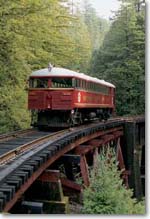
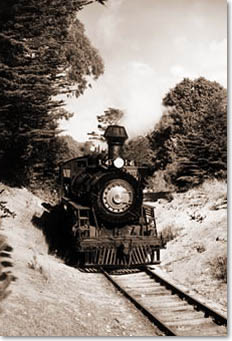
 Except for the passengers' high-tech cameras and modern garb, a time traveler from the last century would feel quite at home riding California Western Railroads Skunk Train in the 1990's.
The view from the restored rail cars is pretty much unchanged: towering trees, deer drinking from the Noyo River, an isolated fisherman's cabin peeking from the forest. With occasional whistles as it chugs through tunnels, over bridges and past open meadows, the train follows the coastal "Redwood Route" as it has since 1885.
Built as a logging railroad, the Skunk line began that year as a logical vehicle for moving massive redwood logs to Mendocino Coast sawmills from the rugged back country. Steam passenger service was started in 1904, extended to the town of Willits in 1911, and discontinued in 1925 when the self-powered, yellow "Skunk" rail cars were inaugurated. The little trains were quickly nicknamed for their original gas engines, which prompted folks to say, "You can smell 'em before you can see 'em."
California Western welcomed more "modern" equipment in later years, which rail fans can still ride. The vintage 1925 M-100 motorcar -- the only remaining train of its kind in use anywhere today -- runs the line year-round, as does the 1935 M-300 motorcar. During the busier summer months, they are joined by three 1950's diesel-powered engines, and famous Old No. 45, a majestic 1924 Baldwin steam engine, the kind most kids dream of when they think "train."
Moving at a leisurely pace, the trains pull covered cars as well as open observation cars -- perfect for capturing photographs of the truly exhilarating journey.
California Western was initially operated as a division of the Fort Bragg mill. In the mid 1960s, Arizona-based Kyle Railways began managing the railroad, and purchased it in 1987. In August 1996, a group comprised entirely of local Mendocino Coast investors purchased 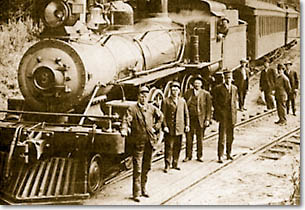 California Western, marking the first time is its 111-year history that the line would be operated as an independent business. Today the Skunk Train is owned and operated by Mendocino Railway.
The Skunk line runs 40 miles from Fort Bragg on the coast to Willits on US Highway 101. Along the way, the tracks cross some 30 bridges and trestles and pass through two deep mountain tunnels. The half-way point of Northspur is popular lunch spot, giving passengers a chance to snack before continuing to Willits or heading back to Fort Bragg.